Printing Technologies Used on Mugs
A mug with your logo is one of those promotional products that usually does not end up forgotten in a drawer. It is used in the office, at home, in meetings, and as a gift. That is exactly why, when ordering mugs, it is worth considering not only the model and price but also which printing technology will achieve the desired result. The right printing method helps convey your brand’s quality, ensures color accuracy, improves the overall durability of the design, and affects both the logo’s appearance and the amount of the mug that can be covered with artwork.
For mugs, the most commonly used method is ceramic printing, which means that after the logo is applied, it is fixed at a high temperature. This method ensures that the colors and logo remain durable, even in the dishwasher, for at least 250 wash cycles, depending on how frequently the mug is used and which washing program is selected. With ceramic printing, it is important to keep in mind that these mugs are usually produced in full-box quantities, starting from 24 pieces.
Other options include pad printing, screen printing, sublimation on white mugs, full-color UV printing, and, on certain products, engraving.
Ceramic printing on mugs
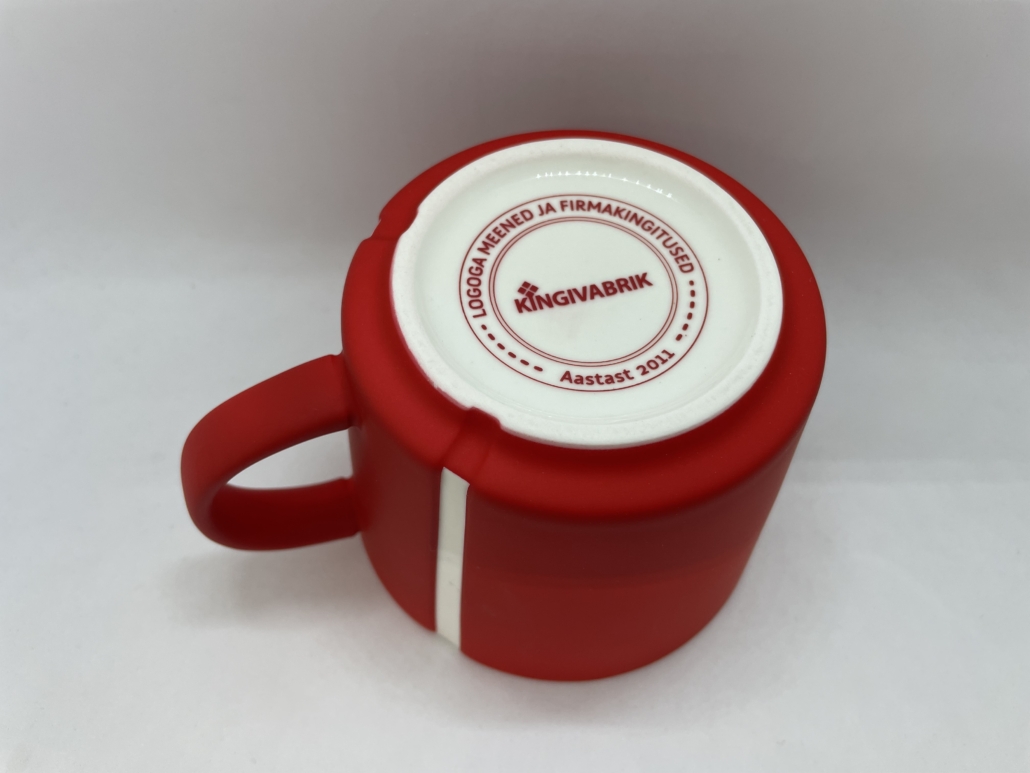
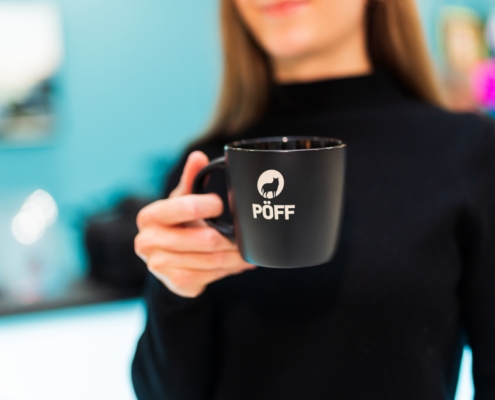
The safest and most durable method for producing logo mugs is ceramic printing. The colors can be defined precisely using PMS or Pantone color codes, the shades come out accurately, and the mug holds up well to both hand washing and dishwasher use. Ceramic printing can be done with up to 8 different colors on one mug. It can also be done more cost-effectively in the CMYK color range, though the colors on the mug may appear slightly duller.
Our ceramic partner, Maxim, also offers many additional options for mugs, such as printing on the handle, inner rim, or bottom, or adding personalized names.
Pad printing on mugs
Pad printing is one of the most common methods for applying logos and text to small hard-surface products, including mugs and thermoses. Its main strengths are the precise results it delivers, even for small text and fine details, and its ability to use specific Pantone colors. In addition, pad printing works on surfaces that are not completely flat, making it suitable for simple logo printing.
At the same time, it is important to note that the print area is usually rather small. Pad printing does not allow for color gradients or photo printing. For mugs, it must also be taken into account that pad printing is not dishwasher safe. It is therefore best suited when you want a clean, accurate logo result, when the order quantity is small, or when the deadline is very tight.
Screen printing on mugs
Screen printing is another classic printing method, alongside pad printing. It is durable but not dishwasher-safe. Its advantage is a larger print area than pad printing and good suitability for larger production quantities.
The limitation is that each color requires separate preparation. Full-color photographs and smooth gradients require special solutions, and for small quantities, the setup cost can make the price less attractive. Screen printing works best on smooth, flat surfaces.
Sublimation printing on mugs
Full-color, photo-quality designs are made possible by sublimation printing. Sublimation is one of the most popular full-color printing solutions for mugs. In this technology, the ink penetrates the material rather than remaining as a separate layer on the surface. The result is a smooth, detailed, photo-quality print that is especially suitable for colorful designs, illustrations, and photographs. For mugs, sublimation is suitable for models with a special polymer coating.
However, sublimation printing has a clear limitation: it is only suitable for white mugs. This means that not every mug can be branded using this technology. If the goal is to achieve a photo-like or very colorful design, sublimation is usually one of the best choices.
Full-color UV printing on mugs
Full-color UV printing is well-suited for applying colorful logos and small details to hard-surface products. Its advantages are full CMYK color, fast production, and good suitability for smaller quantities. If the design is detailed and you want a modern full-color result, and sublimation is not suitable, full-color UV printing is a very practical solution for mugs and other hard drinkware.
However, it should be kept in mind that direct UV printing works best on flat or only slightly curved surfaces. If the product shape is more complex, a better option may be full-color DTF printing, where the design is first printed onto a film and then transferred onto the product. This makes it possible to apply colorful artwork to surfaces where direct printing cannot easily reach.
Laser engraving on metal mugs and thermoses
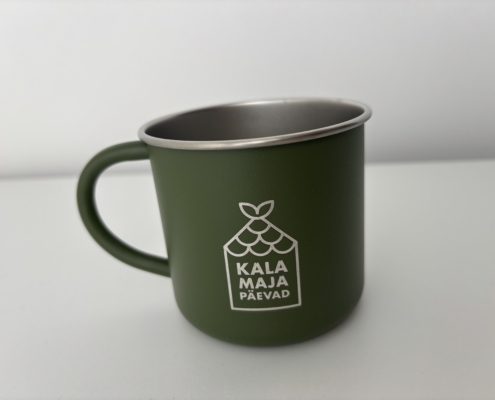
When it comes to metal mugs, thermoses, or stainless steel drinkware, it is worth considering laser engraving. With laser engraving, no ink layer remains on the surface. Instead, the design is burned or etched into the material. The result is a very durable, premium-looking marking well-suited for high-end products.
Laser engraving is not suitable for a bright, colorful logo, because the tone of the engraving depends on the material. However, it is an excellent option if you want a solid, long-lasting, and professional result.
What else does Maxim Ceramics offer?
In addition to classic printing methods, there are also manufacturer-specific special solutions on the market that expand the branding possibilities for mugs. In the case of Maxim Ceramics, it is clear that they do not limit themselves to standard solutions. For example, they offer 360° full-surface printing, sublimation for more complex mug shapes, Solid Shield protective coating, and various Pantone color options, 3D effects, and personalization options. You can find the Maxim Ceramics product range on our website by clicking here.
360° full-surface printing on travel mugs
One of the most notable innovations is Galaxy Digital 360, which means full-surface printing on travel mugs. This printing method enables the entire surface of the travel mug to be covered with a multicolor design and to achieve a photorealistic 360° effect. In addition, it is possible to add a more dimensional 3D effect to make the visual even more eye-catching. This is a good example of how a mug no longer has to be limited to a single small logo but can become a complete promotional surface.
Sublimation Flex, or sublimation for more complex mug shapes
Traditionally, sublimation has been the most convenient solution for straighter mug shapes, but manufacturer Maxim highlights its Sublimation Flex technology separately. This makes it possible to apply sublimation printing also to more complex mug shapes, removing some of the previous technological limitations. It is also important to note that orders can be placed starting from 24 pieces, and according to their tests, this solution withstands at least 500 dishwasher cycles in ULTRA mode. For using the Sublimation Flex method, please ask for more detailed information with a specific inquiry.
Solid Shield and increased dishwasher resistance
One of Maxim Ceramics’ strongest messages concerns the durability of sublimation printing. Their Solid Shield solution is a polymer layer that covers the sublimation mug and helps keep the print intact even after many dishwasher cycles. According to tests published on the manufacturer’s website, decoration with the Solid Shield coating remained intact in a professional Winterhalter dishwasher for more than 2,500 wash cycles in simple mode and at least 1,000 cycles in intensive wash mode. At the same time, they point out that these results cannot be directly transferred to home conditions because machines, programs, and detergents differ.
This is a good example of how, with mugs, it is not enough to talk only about the printing method; coatings and finishes that directly affect durability in use also matter. If dishwasher resistance is important to the customer, it is always worth asking about these additional solutions separately.
Pantone coloring, 3D effect, and personalization
Branding a mug does not only mean applying a logo to the surface. Today, it is possible to color product elements in the same Pantone color, add a 3D effect, and use personalized engraving. For some products, additional options include lid engraving, personal engraving within the Galaxy solution, handle printing, and design personalization within the same project.
This means that some mug projects can be built in a much more complete way. In addition to the main print, consider the product’s tone, surface effect, finer details, and even personalized markings. Such solutions are especially well-suited for high-quality business gifts, campaigns, or smaller but impactful custom projects.
How to choose the right technology?
- If you need a small, simple logo on a classic mug, pad printing is often sufficient. If you are ordering a larger quantity and want a durable, consistent result, choose ceramic printing.
- If the design is a photo or full-color artwork, sublimation or UV printing is usually the better choice.
- If it is a metal mug or thermos and the goal is a premium, refined result, engraving is a very good option.
- If, however, you want a particularly eye-catching effect, broad coverage, or greater dishwasher resistance, it is worth exploring manufacturer-specific solutions, such as 360° printing, Solid Shield, or sublimation, for more complex shapes.
The most important thing is that the printing technology is chosen together with the product, the design, and the intended use. That is when a mug becomes not just an item with a logo, but a well-functioning promotional product or gift that people actually use. See Kingivabrik’s drinkware selection in the drinkware category on our website.